|
|
UC
Graduate Studies Catalog 2019-2023 Section VIII Master’s Degrees |

The aim of these is to provide students with a more in-depth knowledge
and understanding of a particular field of study through courses and research.
There is also the opportunity for students to broaden not only their knowledge
of a particular specialization but also their soft skills, including through
research related to more in-depth studies of a chosen area for the analysis and
presentation of the results in a broader context.
1. The Master’s Students’ Academic
Committee
MoEYS requires that each university establish a committee (their Science Board for Master’s Programs)
to overview applications to study for a Master’s degree and to subsequently
monitor successful applicants’ progress.
Thus the Master’s Students’ Academic Committee at The University of
Cambodia is responsible for the initial vetting of applications based on the
documentation supplied and any follow-up interviews (see Section VI.1).
Thereafter, this committee is responsible for assigning successful
candidates to an advisor from the full- or part-time faculty to assist in
monitoring their progress, more especially in the initial and final stages of
their respective Master’s programs. The
advisor of each student is responsible for routinely keeping the Committee
informed of any problems through the student’s College or School and the Dean
of Graduate Studies.
Based on these and other inputs, the Committee is responsible for
monitoring progress of students who are preparing their Master’s theses or, for
those following the Comprehensive Exam option, their Master’s Research Papers.
Ø Note that the structure of the various options is
different for students joining Master’s programs in Academic Year 2018-9: see Section VIII.7.
Section VI.1 provides detailed guidelines regarding the documentation required to be submitted by prospective students. Those wishing to register for a Master's Degree program at the University of Cambodia must have a good Bachelor’s degree from a reputable university or institution. This should be in a field related to the chosen program of further study, otherwise there is the need to successfully complete Bridging courses to facilitate the transition (see below). It should be noted that individual Colleges and Schools may set additional specific requirements regarding the admission of students.
i. Bridging Courses MoEYS requires that students graduating with a Bachelor's degree in one discipline successfully complete nine credits in ‘Bridging’ courses in order to be considered for a Master's program in another field. This comprises a set of three courses to cover the bare minimum that students should be expected to know in order to be able to cope with the material covered in a normal Master's syllabus. These courses can be done either as formal class-work or through supervised independent or small-group study; all modules should be completed within 1-3 terms. At the same time, students will be exposed to work practices which will benefit them when they continue on to join the selected Master's program after successful completion of the Bridging program. If they pass each of these with at least a ‘B’ grade, candidates will receive a Graduate Certificate from the relevant College or School and can then proceed to register for their chosen Master's program.
Having successfully
completed the required Bridging courses, prospective Master’s students who have
been provisionally accepted must pass the University’s Graduate Entrance
Examination.
Bridging courses cannot
be counted towards the credit requirements of the subsequent Master's degree
program.
ii. Transfer Students Based on the guidelines set by the Ministry of Education, Youth and Sports, Master's students may transfer up to 24 credits from a similar program in the same field at another recognized university. To be considered for transfer, a course must be equivalent to at least 3 credits (45 hours of formal teaching); the subject matter of the course should be equivalent to an existing course which counts towards the student's chosen major at The University of Cambodia; and the student should have scored at least the equivalent of a University of Cambodia ‘B’ grade.
Intending students should submit the original transcripts or study records from their previous institutions together with the relevant form to the Office of Admissions, Information and Registration for further processing.
Ø Where recognized, courses will be recorded in the student's transcript as
their UC equivalents (ungraded and with the annotation that they are transfer
credits), and cannot be repeated at The University of Cambodia.
For successful
students transferring to the International Track, they must first pass the
English Placement Test or provide other evidence for competence in the English
language before they can be admitted into a degree program at the University of
Cambodia.
3. The Overall Structure of a Master’s Degree
(Existing Students)
All existing students are required to complete a minimum of 54 credits to complete their Master’s program. They need to have a minimum overall Grade Point Average of 3.0 in order to file for graduation.
i. The GPA is based on the student’s performance in coursework: subsequent
common exams and performance in research are assessed as either ‘Pass’ or
‘Fail’.
ii. A student is allowed a maximum of three courses with a grade 'C'.
iii. Further courses with this grade count as grade 'F' with a Grade Point of
0.
iv. Note that, where a course is repeated, both scores will be included in
the student’s transcript and will be used to calculate the overall GPA.
Failing to maintain this minimum will mean that extra credits must be
taken in order to try to bring the student’s performance up to the required
standard.
A Master's student must satisfactorily
complete all course-work and then pass a Comprehensive Exam or Thesis defense
within 4 years (48 months) after first joining a degree program, based on
guidelines from MoEYS.
i.
During this time, they can apply for Leave of Absence
for up to one year (12 months): see Section VII.3.
ii.
Where students take longer than this period of time to
complete, they may be required to retake exams taken more than two years
previously; if so, the grades for the repeat exams will replace those for the
original ones in the student's transcript.
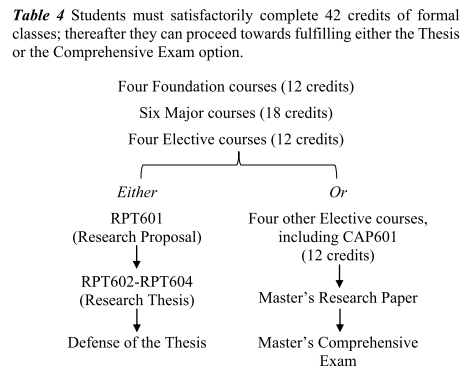
Table 4 provides an overview of the current structure of all Master’s
degrees at The University of Cambodia, based on guidelines issued by MoEYS in
2012. There is:
i.
a suite of four Foundation
courses taken by all students;
ii.
a total of ten core courses
specific to particular degree programs;
iii.
thereafter, students may follow one of two routes in order to earn their degrees.
The following sections will consider each of these components in turn.
Following MoEYS’ latest set of current requirements, all
students are required to take and pass the following four courses early on in
their Master's degree program:
– FDN501: Research Methodology
–
FDN502: Statistics for Research
–
FDN503: Research Paper
Writing
–
FDN504: Ethical Leadership
The last of these
courses, FDN504, was introduced in October 2012 in order
to better prepare our Master’s graduates for future jobs.
These include so-called ‘elective’ courses. All students starting in October 2012 or thereafter have to do ten such courses.
Where a College or School offers more than one major, the courses taken comprise a common suite of core modules taken by all students; together with a number of other major-specific courses to make up the requisite total of ten courses
Thereafter, the student can select to do either the Thesis or the
Comprehensive Exam option.
Ø Note that, after first
registering for either option, MoEYS’ regulations require that a student must
register for each subsequent term (including Term III) until final submission
of an acceptable piece of work.
Ø This is to demonstrate the
student’s continuing commitment to completing their degree program, and to
encourage them to complete their work in as short a time as possible (for the
student’s own benefit).
Ø Thus it is not recommended
that a student takes a Prolonged Leave of Absence (see Section VII.3) during
this time, since they will find it difficult to pick up where they left off
before.
i. Thesis Option The Master's thesis is a scholarly presentation of an original
contribution to knowledge resulting from independent research. Whilst still doing coursework, students who
intend to do this option should plan ahead by identifying an area of interest,
a possible topic for research within that and a potential supervisor in
consultation with their respective College or School.
Having completed the requisite initial 14 courses with a GPA of at least
3.0, a student first proposes to the Master’s Students’ Academic Committee a prospective title and a chairperson (supervisor) from the
College in which the student is enrolled,
together with up to two other members (co-supervisors). Once approved, the
student can then register for RPT601 and prepare a Research Proposal
under the guidance of the appointed
supervisor(s).
After the Proposal has been reviewed by the Master’s Students’ Academic
Committee or its nominees and
successfully defended by the student (with a ‘Pass’), the latter can proceed to
register for RPT602-RPT604 and then collect data, analyze these and write up
the findings according to a standard format.
Ø
A student must register for
at least 3 credits of research and thesis-writing every successive term (with a
maximum of 9 credits in one term) until the results of the original research
are written up in an acceptable form as a thesis.
Ø
Where the student has not
completed their thesis, they can register for up to 15 more credits (i.e.
up to RPT609) in order to do so within the four-year time-limit; failure to do
so means that they drop from the program.
The resulting
thesis must then be defended in front of nominees of the Master’s Students’
Academic Committee, together with a
representative from the Ministry of Education, Youth and Sports as observer.
Based on a majority decision regarding
the outcome of the defense, the candidate may be considered to satisfy one of
the following criteria:
– Pass;
– Provisional Pass with Minor Rewrite;
– Provisional Pass with Major Rewrite; or
– Fail.
In the case of a major or minor rewrite, the candidate must submit a revised version of the thesis, with appropriate documentation of the changes made (or why changes were not made) by an agreed deadline: where necessary, a second defense may be called for.
Ø
However this must be done
within the four-year time-limit for graduation.
Ø
Students who fail the thesis defense a second time are
dropped from the program and lose their status as registered graduate students.
ii. Comprehensive
Exam Option This involves registering for a minimum of twelve more credits in courses
related to the chosen major, including the final three credits which constitute
the Capstone module (CAP601). Note however
that, when the student’s GPA is less than 3.0, more courses will need to be
taken in order to bring the score above the threshold required.
Ø
Students can do up to an
extra six courses (18 extra credits, to make a total of 72 credits) in
order to bring their GPAs to above the requisite minimum within the four-year
time-limit: if they fail to do so, then they automatically drop from
the program.
CAP601 provides the student with the opportunity to take an overview of the material covered in the courses taken in the context of FDN501-FDN504, and develop ideas about the underlying concepts and their interpretation and practical applications. One end-point is the satisfactory completion of a Master's Research Paper (with a ‘Pass’), as required by the Ministry of Education, Youth and Sports.
Having fulfilled the above
requirements, the student can then proceed to register to take the Master’s Comprehensive
Exam, comprising two 3-hour papers – morning and afternoon – on a single day.
This exam requires students to take an integrative approach to what has been
covered during their coursework in order to address more general questions,
giving them the opportunity to demonstrate the breadth of their knowledge and
understanding of their particular discipline. To help them prepare for the exam, which comprises four compulsory
questions in the candidate's chosen field or discipline, their College or School provides a pool of possible questions,
together with further background reading based on a list of recommended
textbooks and other materials.
Students are required to sit
and pass both of the component papers. If this is the case then this will be annotated
as a ‘Pass’ on their final academic transcript; otherwise, a ‘Fail’ will be
recorded.
Ø Where a student
fails one or more papers, they can register to take a re-sit at the next scheduled Comprehensive Exam.
Ø However, where a student scores zero marks in at
least one of the papers in their first Comprehensive Exam (e.g. through
absence or arriving too late to take the exam), then both papers may have to be
re-taken.
A second failure
will mean that this is also recorded as such on the transcript and the student
drops out of the program.
7.Revised Structures for New Students Starting in
Academic Year 2018-9
The latest guidelines from MoEYS, to be implemented for students starting in October 2018, have devised a different categorization of Master’s courses which universities are required to follow; together with a revised program structure and the potential to offer up to three different routes towards doing a degree.
Regarding MoEYS categorization of courses, these comprise:
Ø Research
Methodology courses (9 credits: three of the four Foundation courses done by
current students);
Ø Major Core courses
(12 credits);
Ø Major courses (12
credits);
Ø Major Elective
courses (9 credits); and
Ø Additional courses
(12 credits) for students opting to take the Comprehensive/ State Exam.
Table 5 summarizes the three possible options that a university may offer.
Options 1 and 2 differ in how the last 12 credits have to be earned:
Ø Option 1 requires that the
students take and pass four additional courses; if they maintain an adequate
GPA, they can then sit for the Comprehensive/State Exam, run with MoEYS, which
will be recorded as a ‘Pass’ or ‘Fail’ on their transcript.
Ø Option 2 requires that the
student earns these credits through proposing a small topic for research, make
a presentation on its findings and submitting a Master’s Project Report. Their
performance in the latter will be recorded as a ‘Pass’ or ‘Fail’ on their
transcript.
Option 3 comprises a smaller classroom-based component (21 credits), with the remaining 33 credits being earned from the proposal and satisfactory completion of a more in-depth research project.
Ø It requires that
the proposed research topic leads not only to the production of a thesis but
also the successful publication of a paper arising from this work, as well as
an oral presentation and a workshop.
Ø Their performance
in each of these will be recorded as a ‘Pass’ or ‘Fail’ on their transcript.
|
Table 5 Overview of the new Master’s degree structures to be implemented for new students, starting Academic Year 2018-9. |
||
|
Option 1 |
Option 2 |
Option 3 |
|
Methodology courses |
||
|
Major courses |
||
|
Major Core courses |
Research Thesis |
|
|
Major Elective courses |
||
|
Additional courses |
Research Project Paper |
|