The Examination System and Quality Assurance At the Univeristy of Cambodia
By Angus D. Munro (Vice-President, Academic Affairs)
The University of Cambodia is continually trying to improve itself, and thus the quality of the students which we produce. This is obviously vitally important for our students, since it will increase their marketability and thus their chances of either securing a job or getting the opportunity to pursue further education elsewhere.
Two recent innovations have been important steps in the continuing road towards self-improvement by the University.
1. The introduction of a new grading system.
2. The introduction of a centralized examination system.
The following is a brief report on the impact of these efforts to improve our system of assessing students.
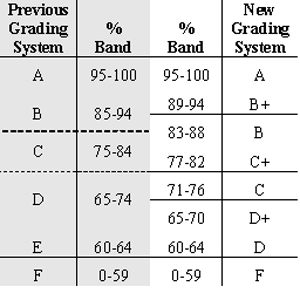
Introduction of a New Grading System: The University
of Cambodia’s President, Dr Kao Kim Hourn, wanted to change the
grading system used at UC in order to raise our standards and
also those of our students. The new system, which evolved
through much discussion, is shown in Table 1 in comparison with
the previous grading system used for undergraduate and graduate
students and that proposed by the Accreditation Committee of
Cambodia which has been adopted by other universities.
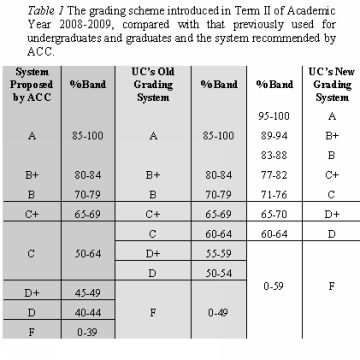
The aim was that, by raising our standards, we would further establish UC as the leading university in Cambodia. Thus what now merits an 'A' at UC is much harder to achieve; and work which earns an 'A' elsewhere might only be awarded a 'B+' or a 'B' here. A knock-on consequence is that students should be encouraged to study harder, in order to meet the new, higher standards for getting a good grade. This is amplified by the fact that we have set the bar even higher for the minimum acceptable mark for the students to avoid failing a course (Table 1).
As might be expected, this caused considerable dismay amongst students: understandably so, since those on scholarships need to maintain a Grade Point Average (GPA) of 2.5 (equivalent to a ‘C+’), whilst other undergraduates need to maintain a GPA of 2.0 (i.e. a ‘C’). Thus, there were many who expressed worries about whether the bar had been raised too high, and that there would be discouragingly high rates of attrition. I must confess that I was also worried, and I suspect some or all of my colleagues were also concerned about the implications.
However, an analysis of the scores for all courses by all students has not borne out these misgivings (Figure 1). Thus, the data for both undergraduates (including Foundation Year students) and graduates indicate that the new scheme has not been as draconian as had been feared.
As might be expected, there has been a marked decrease in the
proportion of students scoring an 'A' in any of their courses.
However, it would appear that a greater proportion of
undergraduates than might be expected got at least a ‘B’,
compared with those who got an ‘A’ under the old system
(although it is difficult to make precise comparisons, since the
lower limit was 85% for ‘A’ and is now 83% for a ‘B’); whilst
the proportion getting at least a ‘C’ is comparable with those
getting at least a ‘B’ under the old system (Figure 1). The
effects for graduates are similar, except that an even greater
proportion got at least a ‘B’ than might be expected, compared
with those who got an ‘A’ under the old system (Figure 1).
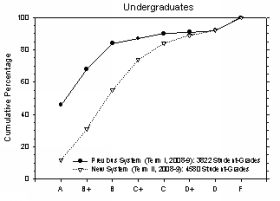
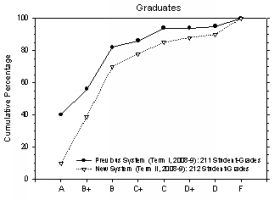
Figure 1 Comparison of the cumulative percentages for
undergraduates (left) and graduates (right) for the terms
immediately before and after introduction of the new scheme.
Given that National Scholarship and other students need to maintain a minimum GPA (see above), and that graduate students are each allowed a maximum of three courses receiving a grade ‘C’ (and none at a lower grade), there will be obvious consequences for some students: for example, this is indicated by the increased proportion of grades ‘C’ and lower for graduates (Figure 1). However the present data indicate that the 'negative' effects were not be as bad as many were predicting; and that they are more than offset by evidence suggesting a stimulatory effect on student performance, as manifest by the apparent increase in the proportion of students (especially amongst graduates) who scored a ‘B’ or better, compared with the proportion receiving an ‘A’ under the previous system.
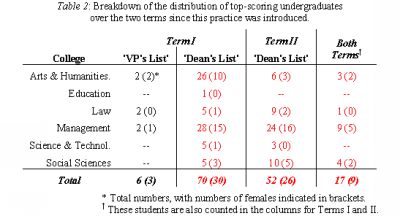
Although we have not tracked the performances of individual students, another set of data gives some interesting hints as to the underlying dynamics. Starting in Term I, we introduced a system for recognizing our best undergraduate students, whereby those who score an overall GPA of 4.0 (equivalent to an 'A') for all five courses taken in either Term I or Term II are placed on the 'Vice-President's List' for that term; and those who score an overall GPA of at least 3.5 (equivalent to a 'B+') for all five courses are placed on the 'Dean's List'. The data (Table 2: excluding Foundation Year students, who are recognized as such only once they have completed their programme) for the first two terms since this was introduced indicate that 6 students (three of each gender) merited inclusion in the 'Vice-President's List' in Term I, but there were none in Term II. For the 'Dean's List', 70 students (30 female) qualified in Term I but only 52 (26) in Term II.
Intriguing results emerge from a more detailed examination of
the data. First, only 17 (9 females) students appear on the
lists for both terms; of these, 4 (2) appear on the
'Vice-President's List' in Term I, whilst the others are on the
'Dean's List' for both terms. Further analysis by individual
Colleges (Table 2) reveals differences which are impossible to
interpret, not least because of the changes instigated in Term
II in the running (see next section) as well as the evaluation
of examinations.
|
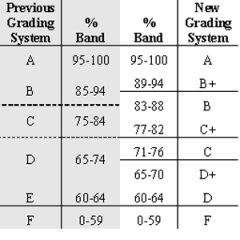
In order to provide a greater measure of uniformity, the same grading scheme was also introduced for CES classes, starting in the first period for 2009. Table 3 compares the old and new systems. Again, this was to the consternation of many students doing the Intensive English Programme, especially those on National and other Scholarships, who now need to maintain a minimum standard of a ‘C+’: under the old system, like other students, they only needed to get an ‘E’.
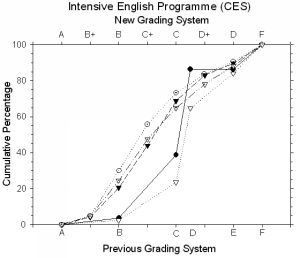
Data on the proportion of students getting different grades in their final course at CES failed to live up to the dire predictions of some. Indeed, Figure 2 shows that students' performances after the introduction of the new grading system have actually improved, rather than declining as had been feared by many students. |
Table 3 Comparison of the grading scheme used previously at CES with that introduced at the end of 2009.
|
The reasons for this counter-intuitive result are not clear.
Possible explanations include that the new system has spurred
students to work harder (one of the original objectives of the
change in the grading system). However the fact that many of the
students are Hun Sen-Handa National Scholars suggests that the
procedures used to select them may have skewed the results for
more recent cohorts. Furthermore, it assumes that the same
marking schedule was used, without markers becoming more
'generous' under the new grading scheme: on the other hand,
there is no evidence that marking has been relaxed. Despite this
evidence for higher scores, however, the introduction of a
higher standard for Scholarship students – the need to maintain
a C+ grade – has clearly had an impact on a number of them
(Figure 2).
|
|
Figure 2 Comparison of the cumulative percentages for the last two periods (all six levels combined) before the introduction of the new grading scheme at CES with the three run thereafter.
|

Introduction of a Centralized Examination System: For grades to have any meaning – for potential employers and other HEIs to trust the more stringent grades awarded to UC students – there needs to be a tight examination system with minimal opportunities for cheating. Our present classrooms are unfortunately rather cramped, and this has inevitably meant that, in the past, those who are lazy and happy to cheat themselves of a better education (as well as giving the wrong signal to those who are honest) have sought to take advantage of the closely-packed conditions to take the easy way out.
For this reason, I proposed a trial-run of a centralized examination system, based on my own experience at the National University of Singapore and discussions with my colleagues. The resultant proposed set of guidelines was supported by Dr. Kao and successfully implemented by Mr. Chheang Sangvath, albeit with the inevitable teething problems: students forgetting to bring their identity cards, or wanting to bring their bags or hand-phones into the examination. The exams were held in The University of Cambodia Conference Centre, under the control of a Senior Invigilator (the Dean or one of the Associate Deans) and a number of Invigilators (the instructors for the courses being examined). Students had to sit quite close together, despite the size of the Conference Centre (Figure 3); thus, to overcome possible problems of students being unable to resist the temptation to copy from each other, Mr. Sangvath organized seating arrangements so that neighboring students were doing different papers.
As a result, after a thorough retrospective review of the operating procedures and how to improve them, Dr. Kao approved the set of guidelines which were established and has decided to institutionalize centralized undergraduate examinations as another means of quality assurance at The University of Cambodia.
Conclusions: Our experience with CES students (assuming all other things are equal - but remember the caveats above) indicates that the change in grading scheme has had an overall beneficial effect on the Intensive English Programme, contrary to the fears of many: indeed, these very fears may have encouraged our students to work harder, for their own good. This benefit will hopefully extend to their increased employability, once prospective employers and others are fully aware of the revision of the grading system.
It is important to note that the ultimate arbiters who decide
the 'fate' of our students are employers and other Higher
Education Institutions: thus it is important that they realize
that our standards are much more rigorous than those of our
competitors, and for this reason we have modified the CES
certificates to show the new grading scheme, so that comparisons
can be easily made with other language schools.
On the other hand, the interpretation of the data for undergraduate and graduate courses is complicated by the fact that two variables – the grading system and the introduction of centralized exams – were changed at the same time. So: do these data tell us anything?
The worst case scenario would have been that students' scores would plummet: they could not cheat, and thus they would score lower according to the old grading scheme, and even worse with the new one. These were my worst fears (assuming that cheating was more common than we suspected), and I am most happy to say that they were not realized. Instead, the evidence suggests that UC students can do well, without the need to cheat themselves as well as others; and that, on top of that, they can live up to the greater demands that we make on them and our (and thus future employers' and the country's) higher expectations of them.